
There is no good evidence that a home high frequency wand reduces acne, and the only bacteria finding is a lab study on dishes, not on skin; at most, a wand may help oily skin look less shiny for a short time. A wand is never used on red, swollen, broken or popped spots, because those count as inflamed or broken skin, so breakouts that keep coming back or are deep and painful belong with a board-certified dermatologist.
Safety first: Do not use a high frequency wand if you have a pacemaker or any implanted electronic device, are pregnant, have epilepsy or a heart condition, or on broken, infected or inflamed skin. Do not use it in or near areas with metal implants, dermal fillers or other injectables. Use a water-based serum only if your manual suggests one, and keep the wand away from oil-based, alcohol-based or flammable products, because it can spark. This guide is educational, not medical advice. For ongoing acne, rosacea or other skin concerns, see a board-certified dermatologist.
This guide draws on the American Academy of Dermatology (AAD), one 2018 lab study and the NuDerma user manual, used as a typical example of a home wand manual rather than a recommendation. Like everything on the site, it sits under the High Frequency Facial medical disclaimer.
Why are breakouts the most common high frequency claim?
Breakouts top the list because brands and salons link the wand to bacteria, which is an easy story to sell. Of all the skin concerns people hope high frequency can help, this is the one they lean on hardest.
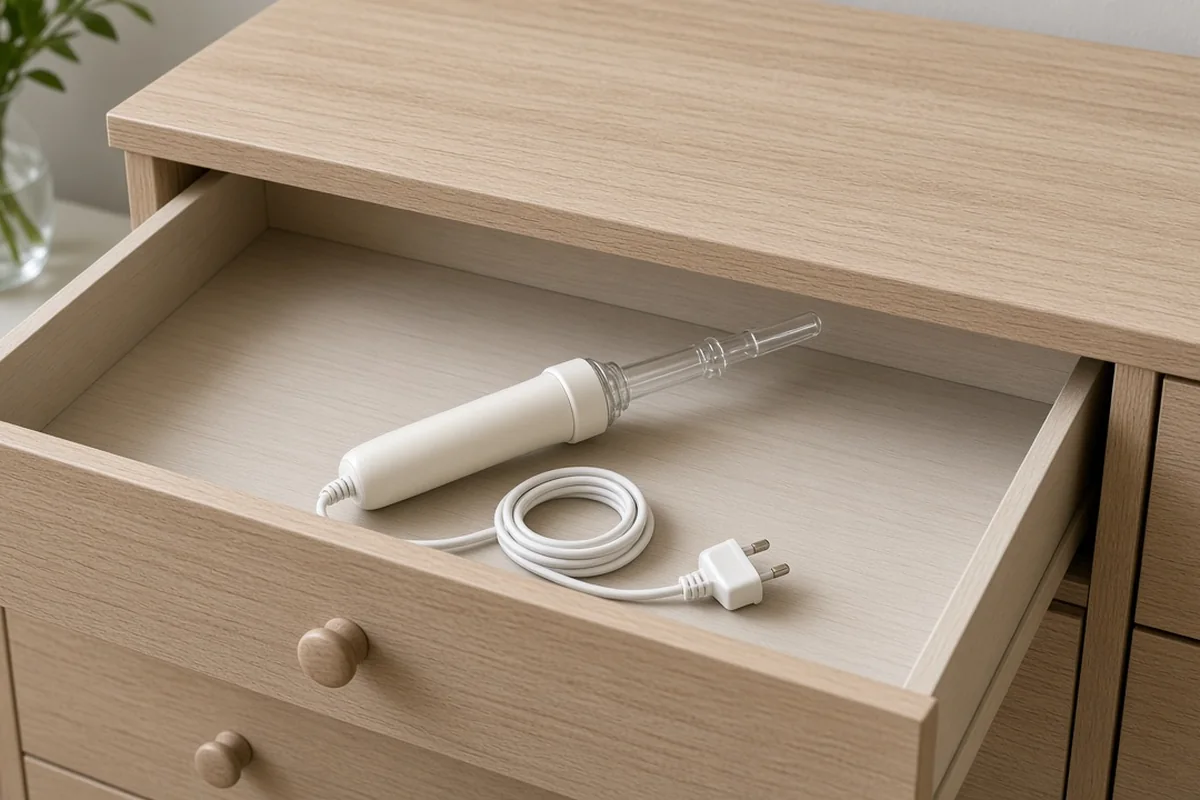
A home high frequency facial uses a handheld wand that sends a gentle electrical current through a gas-filled glass electrode (the glass tip that touches your skin). Many brands and salons say the wand makes ozone and that this helps with the bacteria involved in breakouts. That is a sales claim, not a research finding.
Ozone has antimicrobial properties in lab settings; whether a home wand does this on skin is not well studied. A wand makes only a small amount, but ozone irritates the lungs when inhaled (EPA), so use it in a well-ventilated room, and ask your doctor first if you have asthma or another breathing condition.
Glow color is the other half of the pitch. An argon electrode glows violet or blue-violet, and a neon electrode glows orange-red. Brands often pitch argon for breakout-prone skin, but that pairing comes from marketing and salon tradition, not from head-to-head studies.
What does the evidence on high frequency for acne actually show?
Evidence is limited to one lab study on bacteria, and it did not test skin, people or acne. No good clinical evidence shows that a home wand reduces breakouts in people.
In a 2018 lab study, researchers used a professional high frequency unit on lab cultures of two bacteria, Enterobacter aerogenes and Staphylococcus aureus, growing in dishes. The device reduced or stopped their growth. The authors concluded that the effect “is observed only at high intensity and prolonged time of application” and called for further studies.
Three limits matter:
- Dishes, not skin. The bacteria grew in lab dishes.
- No people, no acne. Neither was part of the study.
- Prolonged contact is not home use. The NuDerma manual says to keep the wand moving, with no more than 10 to 15 seconds on any one area.
So the study cannot tell you whether a home wand changes breakouts.
Why should a wand never touch an inflamed spot?
A red, swollen, broken or popped spot is inflamed or broken skin, and the safety box rules out both. The NuDerma manual has a related rule: do not use the wand on any area of skin with swelling, bruising, cuts, abrasions or infections.
A popped spot belongs in that group, because popping leaves the skin open, and skin like that on the day is a clear sign a high frequency wand is not safe to use at home right then.
Irritation is the second reason. In its list of habits that can worsen acne, the AAD warns: “Anytime you irritate your skin, you risk getting more acne.”
Some manuals, NuDerma’s included, describe tapping a blemish with a narrow spot electrode. This site leaves that step out, because a red or swollen spot counts as inflamed skin.
How can you use a wand on breakout-prone skin that is calm today?
Only on calm areas, briefly, on the lowest setting, and well away from any spot. At most, a session may help the look of oily skin for a short time, and evidence is limited.
At home, use only the direct method, where you glide the glass electrode over your own skin. The indirect method is a salon technique, so if your kit has a saturator (a rod the client holds), it stays in the case. The mushroom electrode, a flat, rounded glass tip, suits gliding over broader areas. Use only electrodes your manual says fit your wand.
The steps below follow the same switch-on order as the site’s guide to using a high frequency wand at home. The skin checks are practical tips.
- Check the area: no red, swollen, broken or popped spots.
- Wash gently and pat the skin fully dry.
- Make sure no alcohol-based product is on your skin. What else is fine depends on your manual; see what to put on your skin before and after high frequency.
- With the wand off and unplugged, fit the mushroom electrode, holding the glass just above the metal base, never by the tip, and never forcing it in.
- Plug the wand straight into a wall socket, with no extension cord, power strip, timer or voltage adapter.
- Turn the dial to the lowest setting.
- Rest a fingertip on the base of the glass.
- Switch the wand on.
- Touch the electrode down on a calm area, well away from any spot.
- Glide slowly, keeping the electrode in contact with the skin and moving.
- Switch the wand off before lifting the glass.
The NuDerma manual sets a maximum of 5 minutes per session, every other day, and says to avoid the direct eye area, eyelids and lips. It also says to stop using the device if you notice a reaction such as an allergic response, swelling, skin discoloration, extreme redness, hyperpigmentation or unusual pain.
What do dermatologists recommend first for breakouts?
Gentle, consistent skin care comes first. Here is the AAD advice in short, from its acne tips for managing breakouts and its habits page:
- Wash gently. Wash up to twice a day and after sweating, using a gentle, non-abrasive cleanser and your fingertips, since washcloths, sponges and other tools can irritate skin (AAD tips).
- Skip drying products. Choose gentle products labeled alcohol-free, and avoid astringents, toners and exfoliants, which can dry the skin and make acne look worse (AAD tips). The habits page adds rubbing alcohol.
- Check labels. Use makeup, sunscreen, and skin and hair products labeled non-comedogenic or won’t clog pores (AAD habits).
- Give products time. Trying new acne products too often can irritate skin and cause breakouts (AAD tips). The habits page says to allow 6 to 8 weeks for some improvement, and that a full result generally takes 3 to 4 months.
- Leave spots alone. Picking, popping or squeezing makes acne last longer and raises the risk of scars and dark spots called post-inflammatory hyperpigmentation (AAD tips).
If you have darker skin tones, that dark-spot risk is one more reason to leave every spot alone, and a practical tip is to try a wand on a small calm area first, since the manual lists hyperpigmentation as a reason to stop. Teen breakouts call for a parent’s involvement, a check of what the manual says about children, and a doctor before any home device.
The AAD tips page puts the next step plainly: “If you keep seeing breakouts after following these tips, partner with a board-certified dermatologist.”
When should you see a board-certified dermatologist about breakouts?
See one when breakouts persist, hurt, mark the skin, or might not be acne:
- Breakouts keep coming back after following the tips above.
- Acne is deep or painful. The AAD habits page says seeing a dermatologist is necessary in that case.
- Spots leave marks or dark spots behind.
- It might be something else. The AAD’s acne diagnosis page notes that what looks like acne may be another condition, such as hidradenitis suppurativa, perioral dermatitis or folliculitis, which need different care.
- You use a prescription acne medicine and want to add a device. Ask your prescriber first.
- You have a diagnosed skin condition. The NuDerma manual says to consult a dermatologist before using the wand.
The same AAD page says there is no one-size-fits-all approach to acne, and that it takes at least 6 to 8 weeks of a plan before you start to see fewer breakouts. Anyone with a condition in the safety box is among the people who should not use a high frequency wand at all. You can look for a dermatologist with the AAD’s Find a Dermatologist tool.
What is the bottom line on high frequency for breakouts?
A wand is, at most, a cosmetic extra, not a breakout plan.
- Evidence for at-home high frequency on acne is limited: one lab study on bacteria in dishes, and no good studies in people.
- Never use it on red, swollen, broken or popped spots.
- Gentle daily care and patience come first, and a board-certified dermatologist is the next step for breakouts that persist.
FAQ
Is there a study showing high frequency helps acne?
No. The only bacteria finding is a 2018 lab study in which a professional unit reduced or stopped the growth of two bacteria in dishes. It did not test skin, people or acne.
Can I use a spot electrode on a pimple?
No. Some manuals describe tapping a blemish with a spot electrode, but this site leaves that step out, because a red or swollen spot counts as inflamed skin and a popped spot leaves the skin open.
Is argon better than neon for breakouts?
No studies show that. Argon glows violet or blue-violet and neon glows orange-red; brands often pitch argon for breakout-prone skin, but that pairing comes from marketing and salon tradition, not head-to-head studies.
Can I add a wand to a prescription acne routine?
Ask your prescriber first, and never use a wand on inflamed or broken spots.
This article is for general educational purposes and is not medical advice.